.png)

Hooray for Fin Lit New Mandates


If your kid is heading back to school this fall, there's a decent chance their state now requires a personal finance class to graduate. 39 states do as of 2026, up from 21 in 2020. The catch is what "requires" means, because some states mandate a full standalone semester (ideal) and others fold these financial lessons into another class (not great) and count it the same way. In both cases, back-to-school this year might come with a personal finance education your kid didn't have a few years ago.
If you've felt for years that school taught your child the Pythagorean theorem but not how a credit card works, this is the correction you've been waiting for. It's real, it's spreading fast, and it's worth being glad about.
Which version does your state have
According to the Council for Economic Education's Survey of the States, more than half the country has decided, in about five years, that money skills belong in the graduation checklist. (So nice to see the usual partisan gridlock isn't slowing this one down.)
The rollout is staggered by graduating class, so the year it hits your kid depends on where you live. Ohio's class of 2026 was the first held to the requirement. Florida, Louisiana, New Hampshire, and Oregon phase in with the class of 2027. Georgia, Indiana, Michigan, Minnesota, South Carolina, and Wisconsin start with 2028. California and Pennsylvania don't fully land until 2030.

So if your child is in elementary or middle school right now, there's a good chance the mandate will be waiting for them by the time they hit high school, whether or not it applies to a graduating senior today. We welcome financial literacy in elementary schools with open arms!
So is it real skills, or just counting coins
Here's the good news for anyone picturing a worksheet on nickels and dimes. The standards behind these courses are the real adult stuff. The strong versions cover budgeting, saving, credit cards, loans, interest, and risk, the things most of us had to figure out the hard way in our twenties.
The catch isn't the standards, it's how much room the policy gives the teacher. A full standalone semester gives them the time to teach it well. A requirement folded into another class, with no extra time built in, asks the same teacher to do far more with far less, and it lands very differently in practice. The standalone-versus-embedded line is the one thing worth checking. NGPF keeps a live map where you can click your state and see exactly what it requires and when it kicks in. If your state guarantees a full standalone course, your kid has a strong foundation coming. If it doesn't, or if the requirement is folded into another class, treat the school's version as a starting point and plan to fill in the rest at home, because an embedded requirement doesn't guarantee your kid gets much.
Financial literacy for elementary school age
There's one more limit. A graduation requirement mostly shows up in high school. And by then a lot of the groundwork is already laid. Researchers at the University of Cambridge found that many of the attitudes and habits behind how we handle money, planning ahead, self-control, delaying gratification, start forming in the early years of childhood, well before a personal finance class ever appears on a schedule. That doesn't mean a teenager can't learn, of course they can. It means the instincts underneath the vocabulary, whether spending feels good, whether earning feels possible, whether a kid sees themselves as someone who starts things, take root early. Waiting until junior year to start shaping them is late, and that's the gap the mandates don't close on their own.
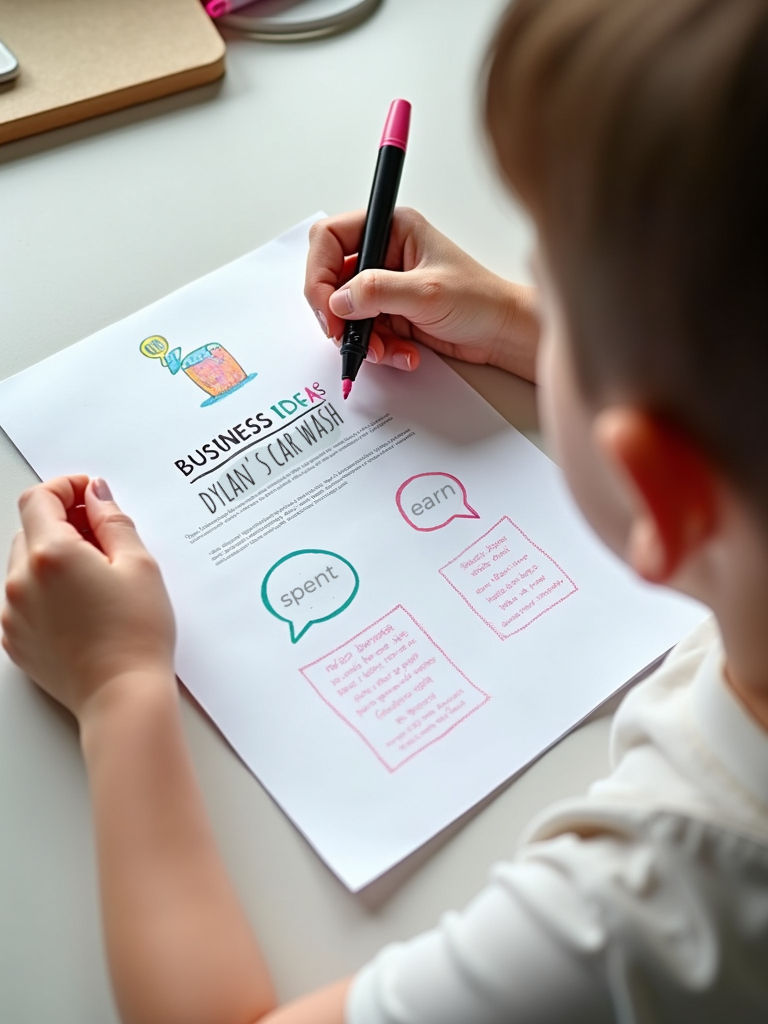
The good news is that the earliest, most important part is also the part that doesn't require a curriculum or a class. It requires a kid, a little bit of real money, and a parent willing to let them make a small decision and live with it. A five-year-old choosing between two things at the store is doing early financial reasoning. A nine-year-old running a weekend stand and deciding whether to spend the profit or reinvest it is doing the exact thing the high school course will later put vocabulary to. None of that needs a textbook. It needs a chance.
So cheer the new mandates. They're a real fix for a real gap. Just read past the headline for your own kid, find out which version your state offers, and start the earning-and-deciding part at home while they're young enough for it to shape their confidence and how they think. The class will teach the words. You get to give them the experience the words attach to.
Here's a rough guide to what you can do at each stage, without needing to be a finance expert yourself:
Sources: Whitebread, D., and Bingham, S. (2013). Habit Formation and Learning in Young Children. London: Money Advice Service.
Council for Economic Education, 2026 Survey of the States. councilforeconed.org/survey-of-the-states
Consumer Financial Protection Bureau, Money as You Grow. consumerfinance.gov/consumer-tools/money-as-you-grow
About the Author

After 25 years in corporate marketing, Suzanne Appel got schooled in business by her kids.
Watching them turn ideas into mini businesses, lemonade stands that became trading and selling collectibles, she knew what it would take to raise kids who create the future instead of chase it: growth mindset, resilience, problem-solving, and the skill an AI world needs most, critical thinking.
In 2019, she launched Young CEO Squad, a hands-on entrepreneurship program that starts with kids as young as 8. Through business-in-a-box kits and school partnerships, Suzanne makes entrepreneurship fun, accessible, and real, giving kids the tools and confidence to launch their own ventures.
More than a product, it's a mission: to reach ambitious kids in all communities, especially those with limited resources. Each kit sold helps fund workshops and, soon, scholarships for young entrepreneurs.
Suzanne lives in Southern California with her husband, two kids, and two scrappy dogs. Her goal? To raise a generation of confident, creative problem-solvers, one kid business at a time.
Support kid entrepreneurship education with a follow, like or comment!
LinkedIn: linkedin.com/company/youngceosquad
Facebook: facebook.com/YoungCEOSquad
Instagram: instagram.com/YoungCEOSquad


Comments