.png)

Inside the Classroom Entrepreneurship Workshop

Most "business kits for kids" are a folder of printable worksheets and a list of business ideas to maybe try someday. That's not what we make. A Young CEO Squad Business Start-Up Kit is a real classroom business in a bag. Kids open it, and within the same lesson they're pricing products, talking to customers, and earning real money. Teachers love that there's no prep or experience needed. No craft assembly, no scavenging for supplies, no guessing what to sell. The product is already chosen, sourced, and packed, so the wall most teachers hit between "I'd love to do this" and "where do I even start" is gone before they begin.
What's in the Classroom Workshop box?
Every classroom kit serves up to 30 students and comes with the same core curriculum, just paired with a different product to sell.
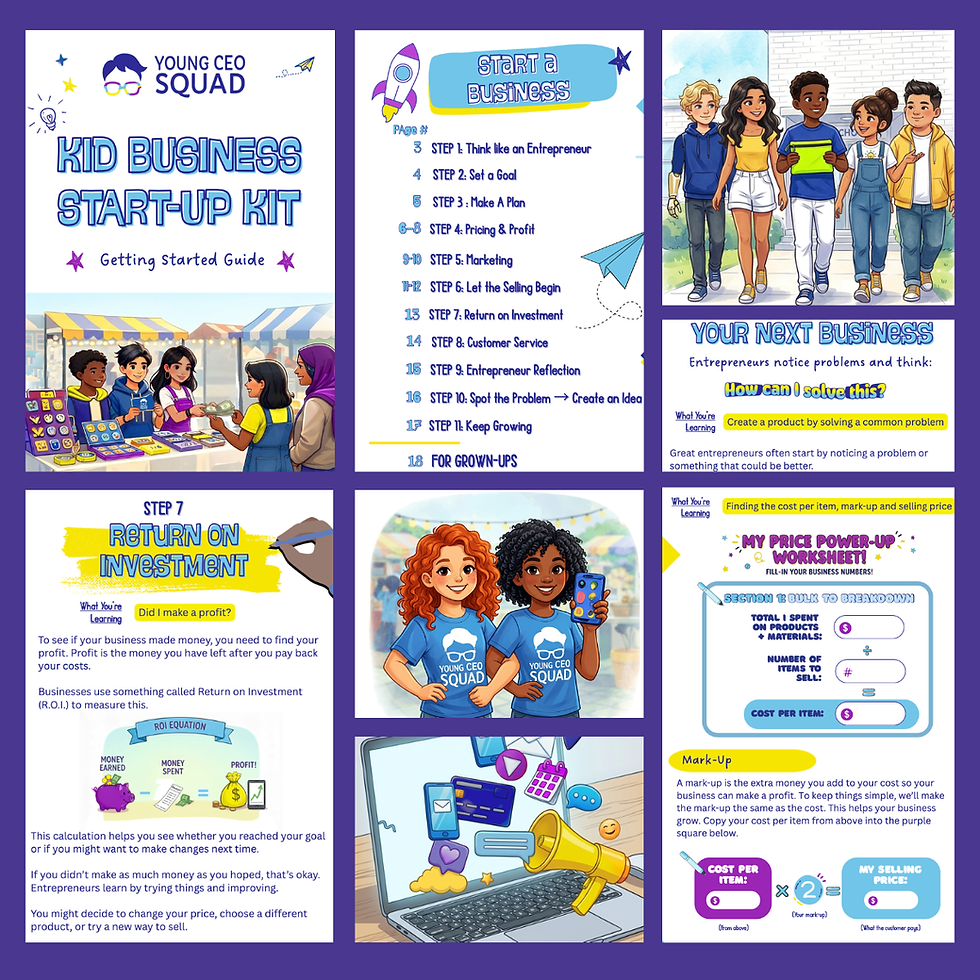
The guidebook is the curriculum. It walks kids step-by-step through setting a goal, thinking like an entrepreneur by treating obstacles as problems to solve, filling out a simple business plan, pricing for profit, and figuring out who their customers are and how to reach them. Teachers can have kids read around the room and pause for the fill-in exercises. It covers real sales tactics like calling, emailing, and selling in person, gives them conversation tips so they know what to say when they pitch Grandpa or record a video, and teaches customer service and how to calculate return on investment. A spending and sales tracker keeps the math visible the whole way through.
There are three kits to choose from:

The Keychain and Charm Business Workshop (above) is the best seller, especially with fifth graders, and it stretches up through older grades. Students help each customer build a custom keychain by snapping charms into place, so every sale is a little consultative sale.

The Reusable Straw Business Workshop works well for younger students in grade 3. Each student gets six silicone straws that fold into a carrying capsule with a cleaner. Six products means a quick win for shorter attention spans, and most customers already know what a reusable straw is, so there's almost nothing to explain at the door.

The Sticker Business Workshop fits grades 3 to 5. Students sell high-quality waterproof stickers that customers can put on a notebook, a laptop, or a water bottle. It has broad appeal and a low price point, so sales come fast.
Whichever kit a class runs, every student gets a reusable business pouch, a Getting Started guidebook written at a 3rd-to-5th-grade reading level and the products to sell.
How a class actually runs the classroom entrepreneurship workshop
A teacher doesn't need a business background to run this. The kit hands them the lesson, the slides, and the products, so the prep work is done.
The shipping box comes with 30 kits. Each kit can be handed out to the students. Inside are guidebooks and products to sell. Some classrooms instruct the students to remove the guidebook and put the pouch inside their desk to keep distractions minimal.
The teacher decides the pacing. We suggest one block a day for five days, then students sell over the weekend with their parents. Opening to the first page teachers can discuss how the teacher will schedule working on the lesson.
In class, students start by setting a goal and filling in a business plan (3 fill in sections). They practice business math to find their cost, their margin and their selling price using the worksheet. Then they sell to family, to friends, at a classroom event, on a quick video, and they track every sale. At the end they calculate their return on investment and see exactly what their effort produced.
The money is real, and that's the part kids remember. Teachers set expectations up front on what the revenue will be used for, whether that's instructing the students to keep it, collecting it for a class party or reinvesting the profits into a refill pack to keep the selling going.
What kids walk away with
The hands-on fun is the hook. The skills are the point.
Running a real business teaches goal-setting, pricing, marketing, sales, customer service, and ROI, the same skills that show up in any career, dressed up as something a fourth grader is excited to do. Alongside that, kids build the parts that are harder to teach from a textbook: confidence from talking to adults, resilience from hearing "no" and asking for the sale anyway, communication from pitching a stranger, and a growth mindset that treats a setback as a puzzle instead of a wall.
For a lot of students, this is the first time they've held money they earned themselves and felt the line connecting their effort to the result. That feeling tends to stick.
Why hands-on beats hypothetical
Think back to your own years in school. For most of us, the lessons that stuck weren't the worksheets, they were the few projects where we made something real. A classroom business is that kind of memory. Kids aren't reading about entrepreneurship or pretending to run a company in a simulation. They're doing it, with real products, real customers, and real money, and the lessons land because the stakes are real too.
That's the whole idea behind the kit, and it's why teachers in more than 300 classrooms across the country reach for it instead of building a unit from scratch. Open the box, and a kid runs a business this week.
Our classroom entrepreneurship workshops consistently are rated 5 of 5 stars by teachers. If you know a teacher who'd love this, send it their way.

About the Author

Suzanne Appel is the founder of Young CEO Squad. After 25 years in digital marketing, she launched YCS in 2019 after watching her own kids build little businesses and surprise themselves with what they could do. Her mission is to put hands-on entrepreneurship in front of ambitious kids everywhere. She lives in Southern California with her husband, two kids, and two dogs.


Comments